I’m Jacob, and I’m the lead developer of the original Radio Commander, released in 2019, as well as the upcoming Radio Commander: Battle of Britain ’40 - a sequel that gives us the opportunity to take the fundamental idea behind Radio Commander and transform it into something new.
In the last dev log, I talked about how I struggled with the idea of making a sequel in the first place, what ultimately inspired me to create one, and the setting we chose as a result. Today, I want to talk about all the initial assumptions we formulated at the very beginning of the project. Let’s treat this as something like a pitch deck for the game we were about to make.
Systems over story
First of all, we wanted the sequel to rely heavily on systems - dynamic elements that react to the player - while moving away from most of the narrative elements found in the first game. That meant fewer characters and dialogues, and much less static storytelling.
Our assumption was that focusing on design and technology would allow us to work with a small, focused team. It would also make it possible to show the game to players relatively early in development. From the beginning, we were thinking about a community-driven development process and building up the game’s presence on Steam while it was still in development. The idea was simple: make the systems work, get them into players’ hands, listen to feedback, and evolve the game together with the community.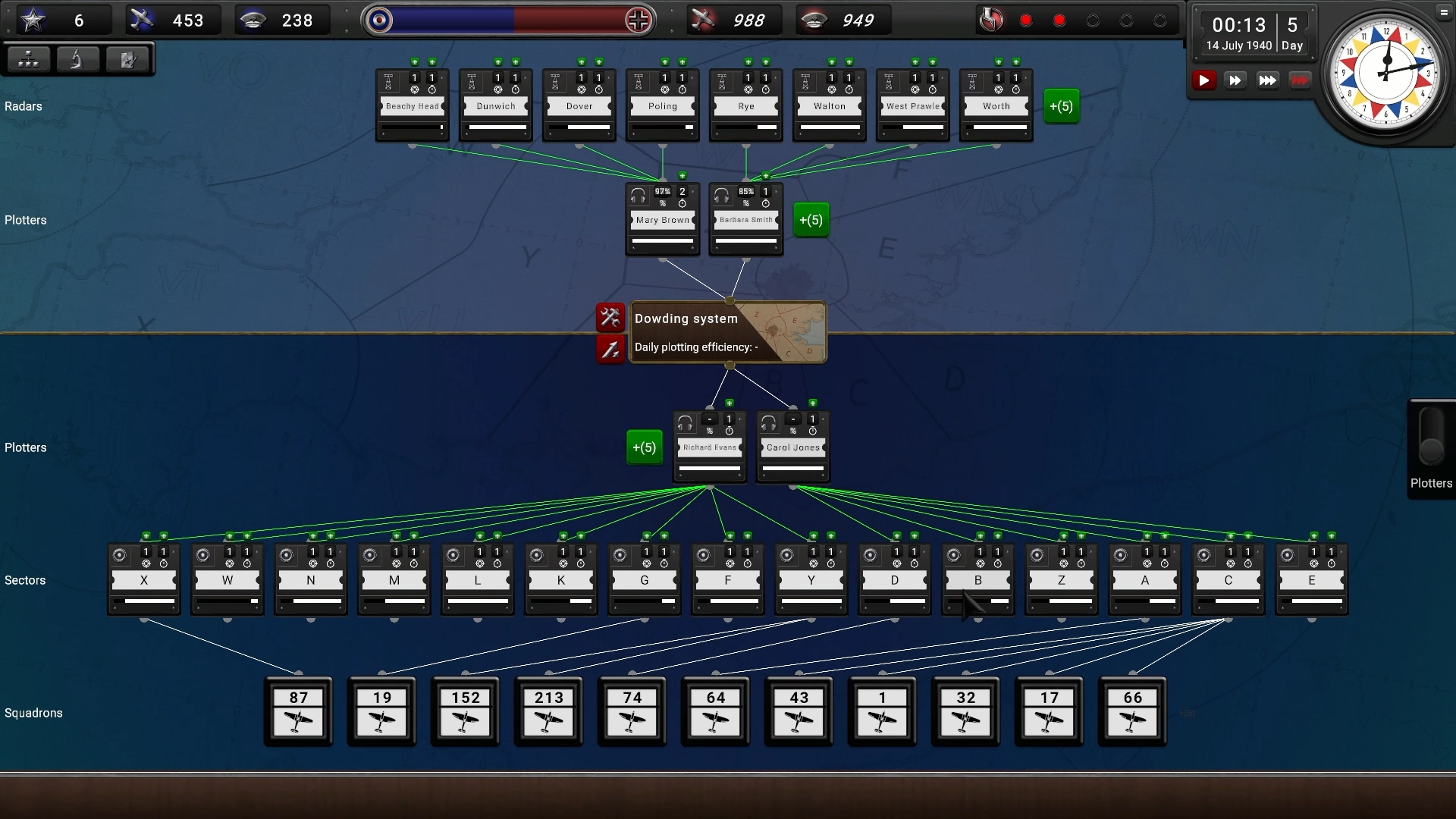
Radio Commander: Battle of Britain ’40: Dowding system panel
WWII as our playground
I love history, and I’m particularly fascinated by World War II. There was also a practical advantage to choosing WWII as the setting: it’s highly recognizable and, unlike many fictional universes, it comes without the constraints of a proprietary IP. We wanted to use that familiarity to our advantage. Players already have some understanding of the period, its technology, and its major events. The core idea was that you are put in charge of defending the United Kingdom against Nazi Germany’s air force.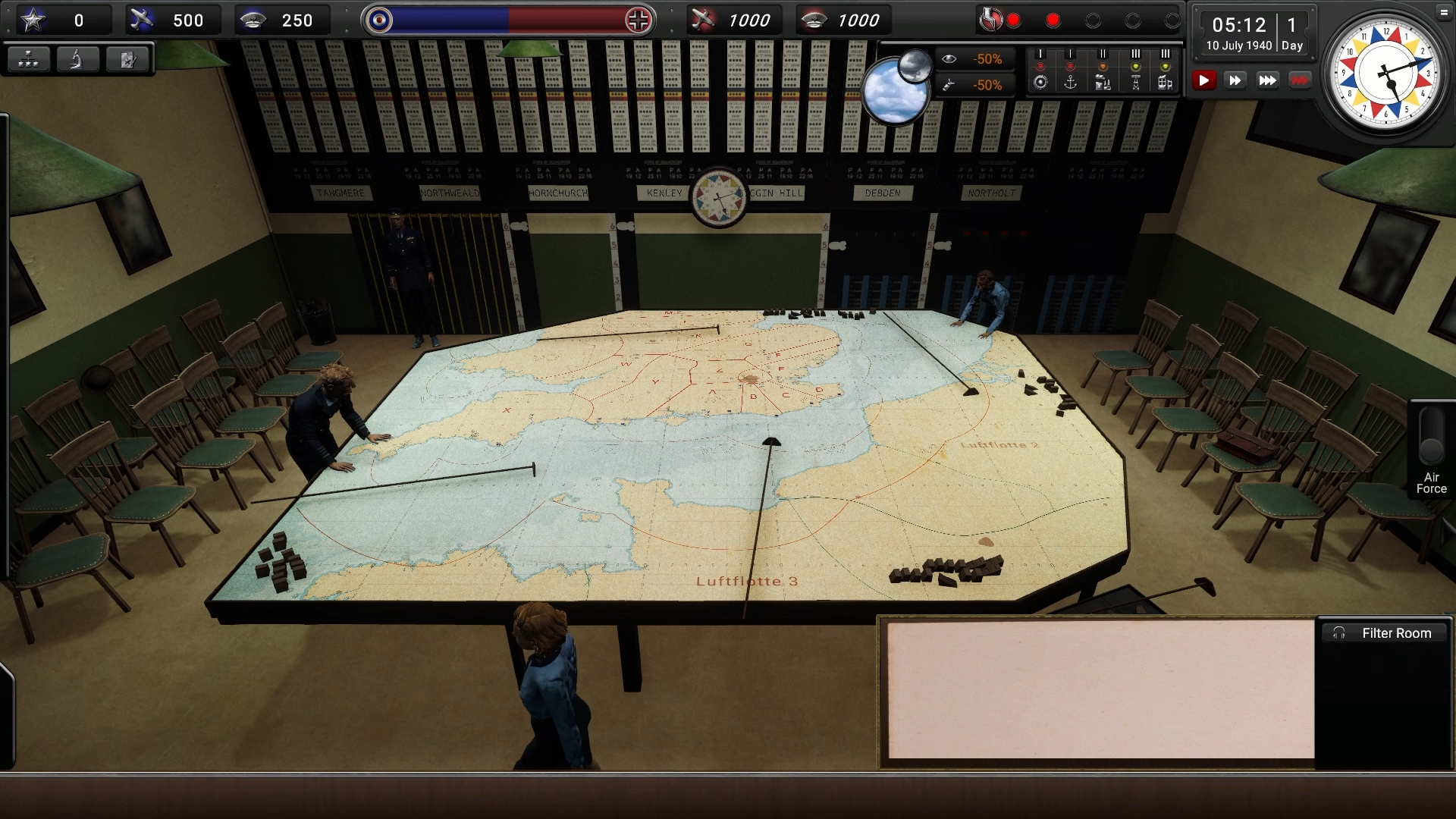
Radio Commander: Battle of Britain ’40: Fighter Command Filter Room
More strategy, less simulation
One of our assumptions was that the new game should lean more heavily into strategy and wargaming, rather than being purely a “simulator” type of game.
In Radio Commander: Battle of Britain ’40 you still have no direct control over individual aircraft. Instead, you are sitting in front of a map with a radio, trying to understand what is happening and coordinate the response. You gather information, you assess it, you keep track of the situation, and then you give commands. That fundamental interaction - gathering information, building a mental picture of the battlefield, and making decisions based on incomplete information - was something we wanted to preserve from Radio Commander, while expanding it into a much deeper strategic experience.
On top of that core, we wanted to introduce two completely new layers.
The first was resource management. You would have a limited number of fighter aircraft, trained pilots, A-A defenses and have to consider fatigue, morale and experience factors. Every decision would therefore have a cost. Sending fighters into the air might solve an immediate problem, but it could also leave you with fewer resources when the next attack arrives.
The second layer was the ability to build and customize the Dowding system itself. Players would earn points that could be spent on upgrades, improving the capabilities of the system. More importantly, you would be able to change its layout and configure it to better suit your needs.
The idea was that the command infrastructure itself would become part of the strategy. You wouldn’t simply use a fixed system. You would gradually shape it into something that reflects your priorities and your way of playing.
Radio Commander: Battle of Britain ’40: Basic decision flow of the game
One long campaign
There was another major assumption: we wanted to move away from the rigid mission-after-mission campaign structure of the original game. Instead, we envisioned one long campaign covering the historical period of the Battle of Britain - three months and three weeks. Rather than starting a new, self-contained mission every time you played, you would remain responsible for the defense of Britain throughout the entire campaign.
Attacks would come and go. The situation would change over time. Your available resources would fluctuate. And you would have to respond to whatever challenges emerged. The goal was to make the campaign feel less like a sequence of missions and more like one continuous strategic problem.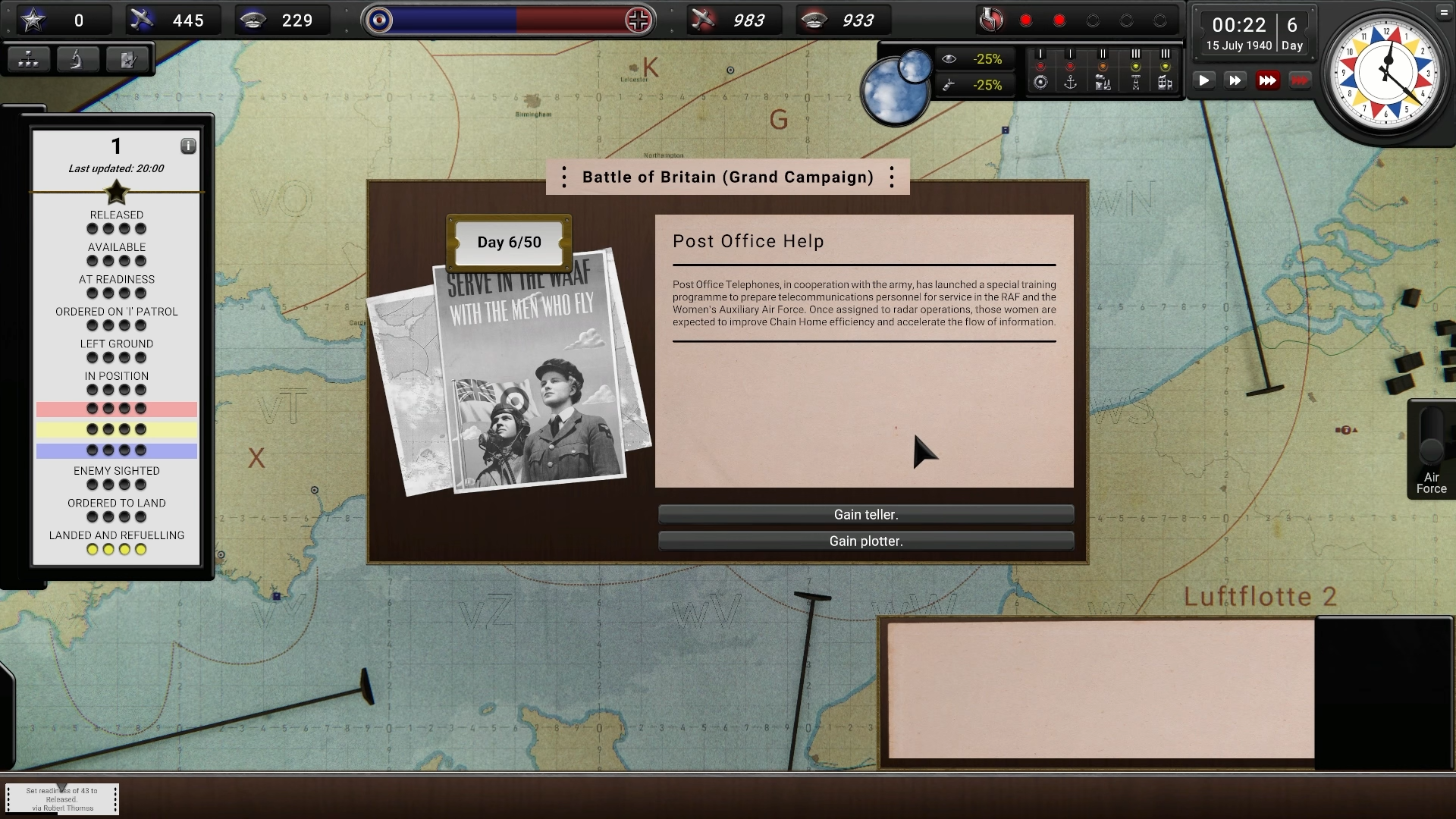
Radio Commander: Battle of Britain ’40: Historical events of the grand campaign
The big question
At the ideation stage, all of these assumptions seemed to fit together naturally. But there was one question that kept coming back to us: how realistic should the game actually be?
Historical accuracy and realism are a big part of the appeal. They can make the player feel like a genuine military commander and give weight to every decision. At the same time, realism can easily turn into unnecessary friction. A mechanic can be completely authentic and still make the game less interesting or less enjoyable to play. That meant we had to find a balance between two things that don’t always naturally go together: creating a believable historical experience and making a game that is genuinely fun to play. Finding that balance turned out to be one of the biggest challenges of the project.
But that’s a topic for the next tale.