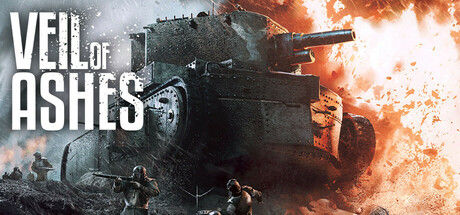
Our second monthly Dev Diary gives an overview of our vision for Veil of Ashes, explores the lore, and takes a brief look at the key features shaping the game.
Vision
Our vision for a strategy game began with a wish – back when we hadn’t even imagined we’d ever develop a game of this kind. We wanted a game where you could feel the weight of the tanks – where you could sense just how massive and powerful these vehicles are.
Many years have passed since then, and our vision has changed and evolved alongside the development of Veil of Ashes; it has also had to adapt to the limits of what we, as a small team, can and cannot achieve.
Veil of Ashes is a real-time strategy game inspired by the dynamics and atmosphere of the classic title World in Conflict. And we’re extending that with more realism and more distinct factions in a fictional setting. We want to bring to life what we enjoy most about strategy games:
commanding cool units across the battlefield, developing new strategies and tactics, and experiencing thrilling battles where you always have something to do and never feel as if you've run out of options.

Lore
Veil of Ashes is set in an alternative-historical world where the end of the world is coming, but is still several decades away.
200 years earlier, on 13 July 1704, an apocalyptic inferno descended upon the world, the origin of which remains unknown. The consequences were devastating and altered the course of history for empires and societies. With the inferno came Cinium. Small as pebbles, white as angel’s feathers and brimming with energy just waiting to be ignited.
Yet the inferno left behind not only Cinium and scars that cut like swathes across the continents, but also grey patches.
Deserts of ash.
For a long time, the deserts — within which an unreachable fire rages — spread only slowly. Hardly anyone noticed. But in recent decades, their expansion has begun to accelerate rapidly. In storms of ash and embers, the deserts are spreading abruptly. Regions are thrown into chaos and buried beneath the grey carpet. The climate is becoming increasingly chaotic, and the blue of the sky seems more and more like a distant memory.
Although the setting encompasses the entire planet, in Veil of Ashes the focus will be on the heart of Europe, where the Lohenreich – which seems like a relic from a bygone age – is confronted with those ideologies that are still capable of offering people hope. The Sacrum Imperium in the south emerges as a new and last church with a promise of salvation, whilst in the west the socialist communes have renounced the old social contract of the estates.

The backstory behind Veil of Ashes was created for the following reasons:
-
One of our team members absolutely loves developing new worlds.
-
We didn’t want a setting based on the Second World War, the modern era, or a classic science fiction scenario. There are simply already so many games that do these settings brilliantly; there’s no need for us to do the same thing all over again.
For the first reason, we have a great amount of background information on our website that can only be touched upon briefly in the game. The lore of Veil of Ashes is not born out of necessity, but out of a passion for world-building. As such, it is more than just a loose framework for roughly explaining the factions’ intentions and designs. It is a setting that extends beyond the game Veil of Ashes.
A big thank you also goes to the community, who – through their questions, discussions and, now and then, criticism (e.g. regarding how our fictional resource ‘Cinium’ works within the lore) – have contributed not only motivation but also ideas, improvements and even their own content.
Features & Content Overview
Our vision and this glimpse into the lore might give you an idea of what we hope to create with Veil of Ashes. And now we’ll give you a brief overview of the content and features we’ve specifically planned.
Please note! We’re only touching lightly on the features and content here. There will be separate posts on some of these topics over the coming months.
Units, but no basebuilding
The most important aspect of a real-time tactics game are the units. In Veil of Ashes, there is no base-building, so the main focus is on your soldiers and vehicles, which you call in directly to a landing zone on the edge of the battlefield using a transport aircraft.
You have access to infantry, vehicles and massive behemoths, each playing an important role in battle. We’ll reveal more about the different unit types and what makes them unique in future content and dev diaries.

Armour & Condition Effect System
One of the most frequently asked questions is whether our armour and unit damage model is structured in the same way as in Call to Arms – Gates of Hell: Ostfront.
The answer is that we want to design our vehicles in particular to be realistic, but we will not be trying to compete with Gates of Hell.
Our armour system is based on separate armour hitboxes for the front, left, right, rear and top of each vehicle. A projectile’s armour-piercing value determines the probability of whether or not it will penetrate and cause damage. The probability curves depend on the projectile type (kinetic and explosive). This system has already been implemented.
Another feature will be the Condition Effect System, which we’ll use to simulate internal vehicle components, such as the engine or the crew – unlike in Gates of Hell, there won’t be a crew that can get in or out.
Only the basic elements of the Condition Effect System will be available at the time of the Early Access release.
Factions
The Sacrum Imperium and Lohenreich factions are planned for the Early Access release. In the time leading up to the full release, the Communes are set to be added as a third faction.
Each of these factions is divided into up to three armies (we call them ‘roles’) to increase tactical depth, with each role having different strengths and weaknesses.
Destructible Environment
The environment is – as far as possible – destructible. Shells leave craters. Buildings – depending on their size – are destroyed in a modular fashion, and trees (and many other objects) are knocked over when a tank drives into them. For us, environmental destructibility is an integral part of the atmosphere.
Tactical Strikes
Tactical strikes have now become a standard feature in many strategy games. And so we’re not keen to do things any differently. We’re currently working on the first off-map artillery strikes, and at some point we’ll move on to air strikes – no, you won’t be able to control the planes yourselves (sorry).
In terms of balancing, this will be an interesting challenge, because on the one hand, strikes should have a noticeable impact, but on the other hand, we want to avoid units appearing worthless simply because artillery strikes make short work of them.
Company Based System
We plan to divide the match into phases to make progression more interesting. This means you won’t start with the most powerful units, but with scouts and light vehicles, and over time you’ll select new companies to expand your unit list. However, choosing one company always means you’re not choosing others. So, to try out all the companies, you’ll need to play several matches.
There’ll be a separate Dev Diary post about this system in the future.
Campaign
The campaign is one of the most important features, which we’ve only finally been able to tackle thanks to our collaboration with Slitherine (our publisher). We racked our brains as a team over various concepts and ultimately settled on an approach which we're calling a ‘semi-linear conquest campaign’.
So it won’t be a linear campaign with fixed missions, nor will it bear more than a passing resemblance to the Conquest mode as seen, for example, in Dawn of War: Dark Crusade. We’ll aim for a compromise that takes into account our capacity as a small team, whilst at the same time allowing us to tell a story and bring the world behind it to life.
To conclude this dev diary
We hope this post has given you a better understanding of our perspective as developers on Veil of Ashes. We could write entire blog posts on some of the topics we’ve touched upon, as many features are the result of years of thought and deliberation.
We also often receive ideas and suggestions from the community about the content and features you’d like to see in Veil of Ashes. Even if our response is often ‘We’ll have to see’ or ‘We’ll make a note of it for the post-release list’, we’re very grateful for them, as they help us understand the direction the game needs to take to make you happy.
If you have any questions or comments, please feel free to post them in the comments section and join the community on Discord to not miss any of our exclusive insights and updates!
Wishlist Veil of Ashes now: https://www6.slitherine.com/game/veil-of-ashes