From the moment a realm gains access to its first gunpowder units, the military landscape begins to change irreversibly.
This transition usually occurs when an army list reaches Tier IV, typically between 1350 and 1400 depending on the nation. More advanced realms may reach this point earlier if they have accumulated sufficient military expertise and maintain a well-educated capital. Gunpowder is not simply unlocked; it is earned through long-term investment in institutions, skills, and infrastructure. With the emergence of handgunners, culverins, and bombards, no fewer than fifteen new military buildings become available. Some focus on organizing and sustaining gunpowder production, others on adapting fortifications to this new threat, and several serve as intermediate steps that reflect the slow and costly transformation of medieval warfare.
Gunpowder on the Battlefield
Culverins represent the first truly versatile field artillery. They perform well in siege attack and are particularly effective in siege defense, while also providing solid ranged fire support on the battlefield. Bombards are more expensive and cumbersome, but devastating. They excel in both offensive and defensive sieges and are slightly stronger in open battle, though their true purpose lies in reducing walls rather than formations.
Handgunners come in several variants depending on culture and army list. On the battlefield they remain fragile, yet potentially devastating. When properly supported, their firepower can decisively weaken enemy formations before contact. Their use marks a shift toward coordinated fire and combined arms, moving away from purely shock-based tactics.
Naval warfare is also transformed. Cannon-armed galleys and roundships appear, introducing artillery duels at sea and enabling devastating naval blockades against nations that lose naval superiority. Gunpowder weapons remain temperamental. Rain, humidity, and harsh weather conditions can significantly reduce their effectiveness, especially in difficult terrain. Firearms are powerful but unreliable, and commanders who depend on them without preparation may be disappointed.
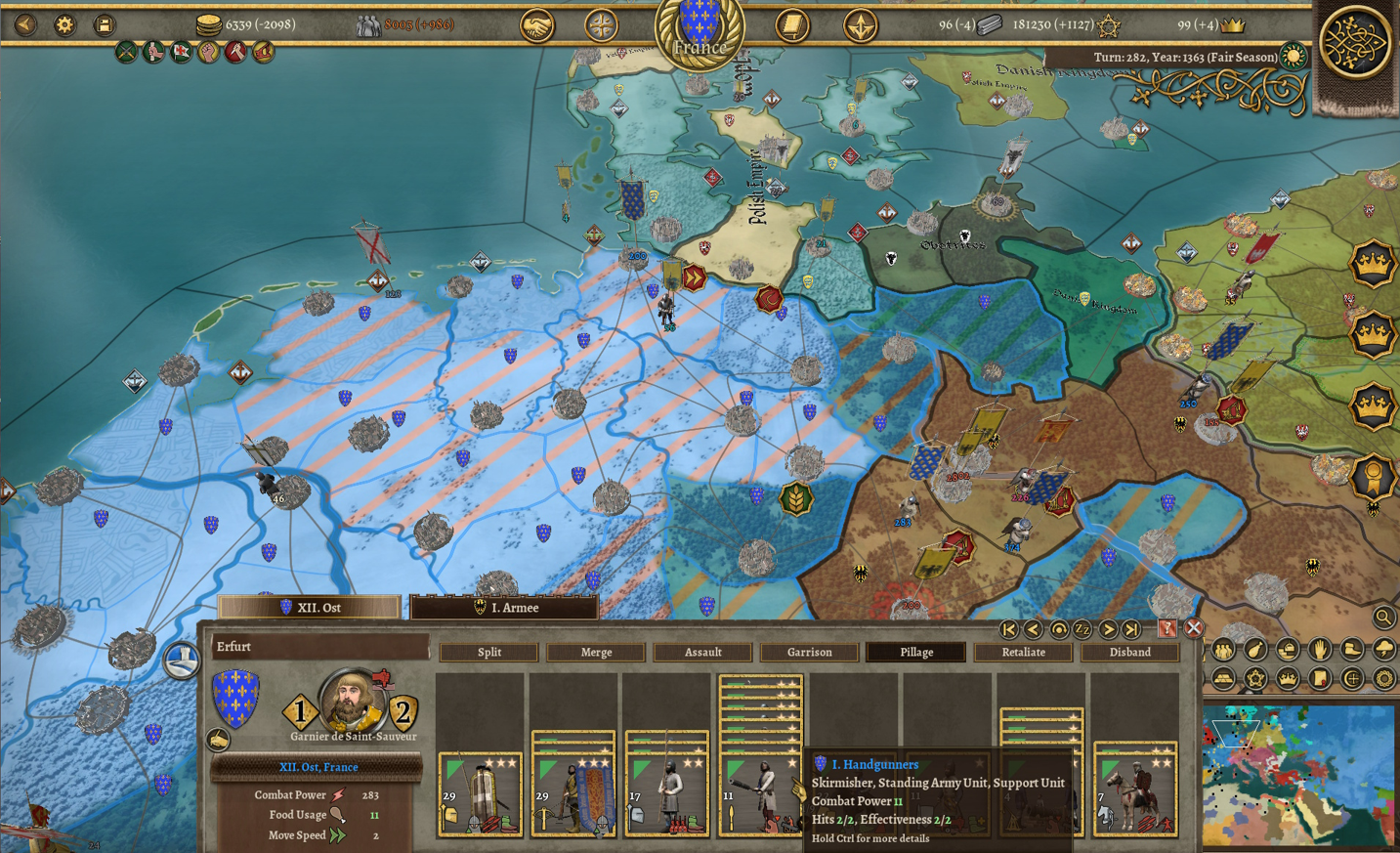
Handgunners are a ranged unit that will greatly weaken the enemy line. They do, however, require the possession of several specific buildings
Producing the Powder
Gunpowder warfare requires dedicated infrastructure. It cannot be sustained through improvised means. From a design perspective, this is represented by a full three-building production chain that relies directly,on the game trade system, allowing for a relatively fine-grained simulation of supply and constraints.
The first step is the establishment of saltpeter works, facilities devoted to extracting and refining natural nitrates from earth, waste, and decomposed matter. While essential for warfare, these installations also bring secondary agricultural benefits thanks to their nitrate-rich residues.
Gunpowder workshops follow. These semi-artisanal facilities are where saltpeter, charcoal, and sulfur are milled and mixed into usable powder. Production remains slow, hazardous, and far from standardized. Units recruited in regions lacking such workshops suffer penalties, reflecting poor drilling and unreliable powder quality.
Artillery foundries are required to cast bombards. These specialized yards produce standardized cannon pieces in bronze or iron under royal or civic supervision. Recruiting heavy artillery without the proper industrial chain again results in penalties, reinforcing the idea that gunpowder warfare depends as much on logistics and organization as on battlefield skill.
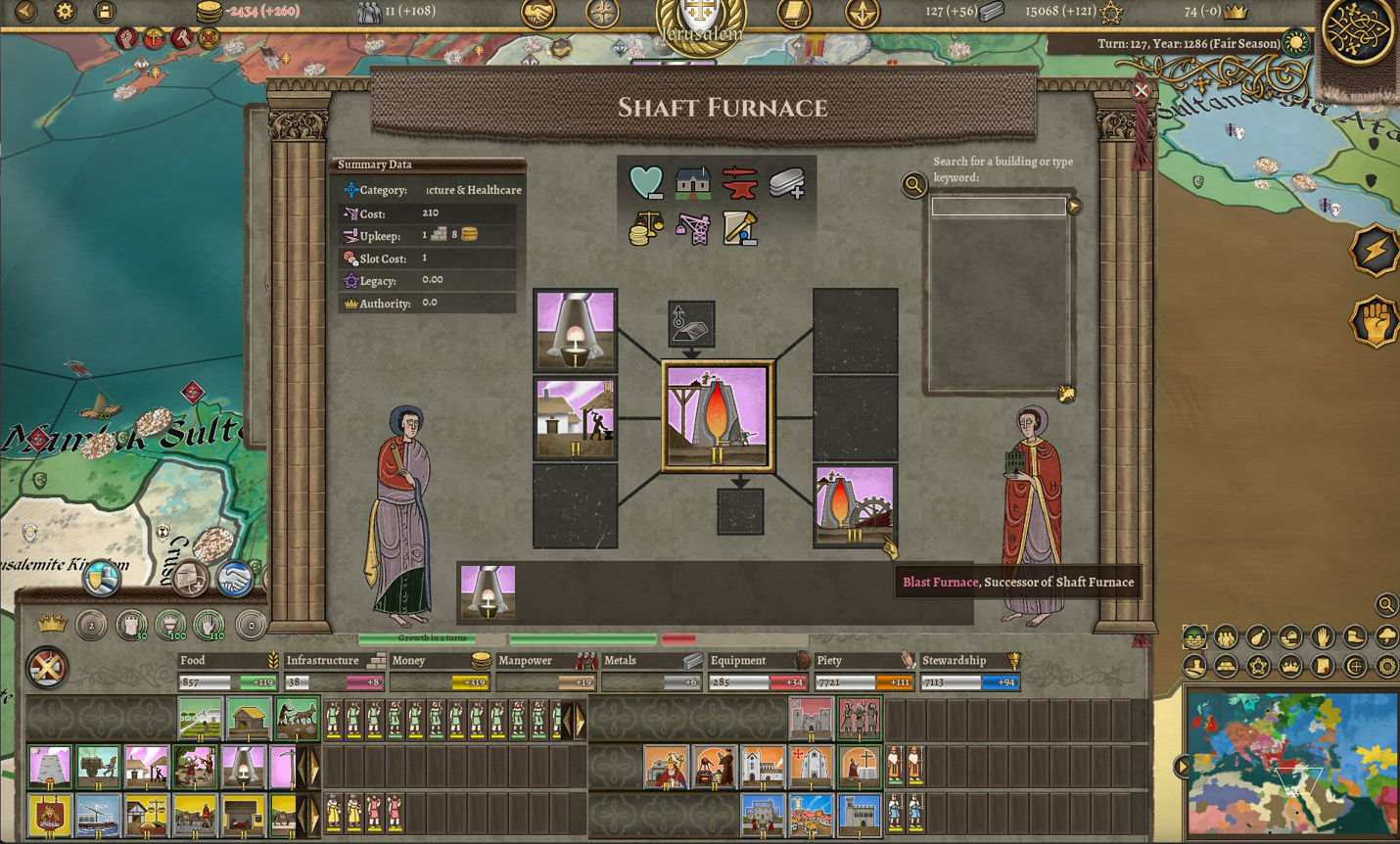
An increasingly rationalized and substantial steel production will be required to build your bombards and culverins
Castles Under Fire
The rise of artillery signals the decline of traditional vertical fortifications. Gunpowder artillery gains massive bonuses against all classical medieval castles. A bombard, for example, is worth more than two and a half trebuchets against a non-adapted fortress, even a high-tier concentric castle. Against an artillery-adapted stronghold, its effectiveness drops sharply, falling below that of a trebuchet.
This forces rulers to make difficult choices. Three new permanent fortifications become available: the Bastioned Castle, the Artillery-Adapted Castle, and the Sloped-Wall Castle. All are costly and demanding, and they compete directly with late-tier classical castles. Modernization is never automatic. It requires a careful assessment of future threats, neighboring powers, and likely conflicts. Investing too early may cripple an economy, while delaying the transition can prove disastrous.
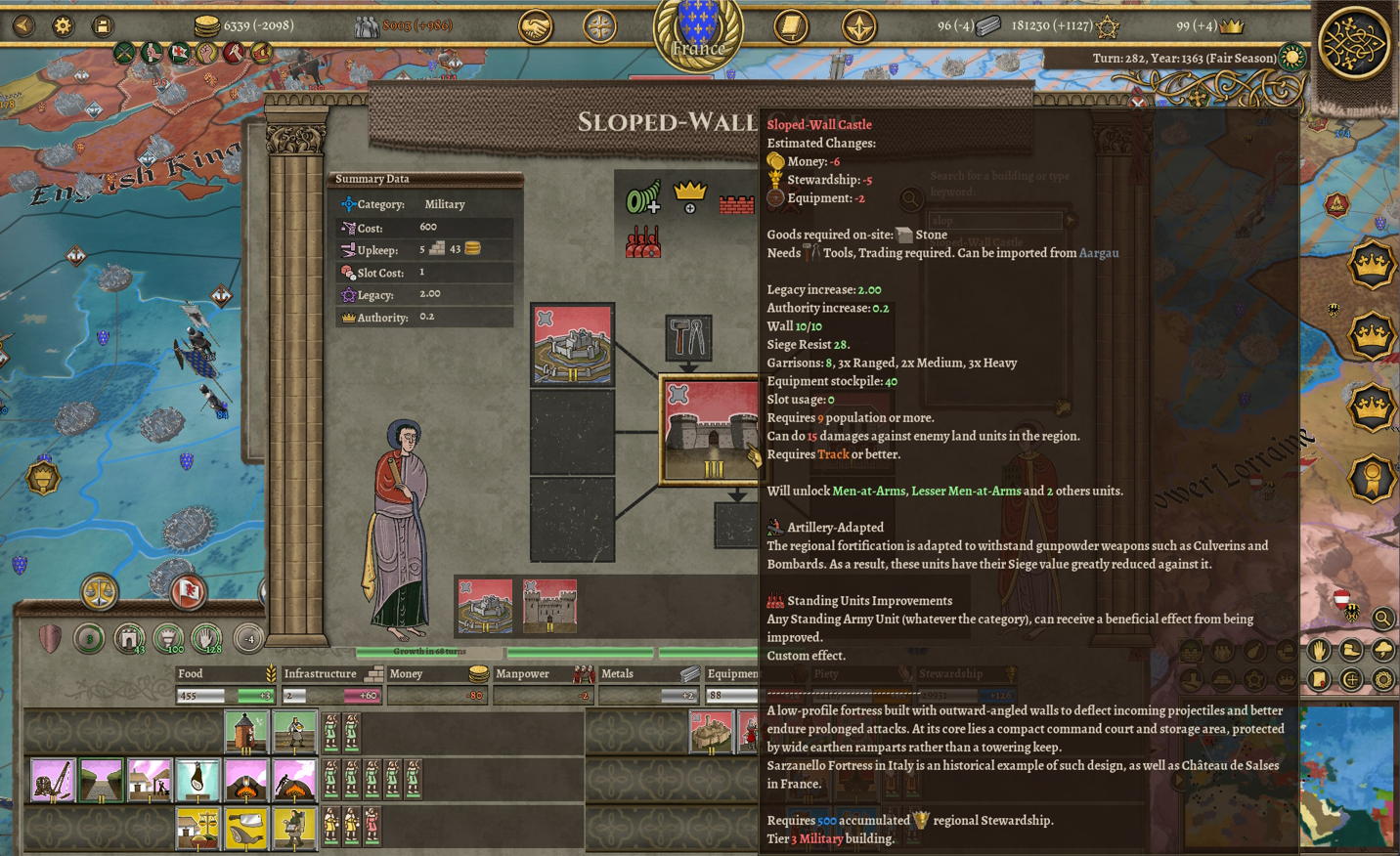
The ultimate stage of late medieval adaptation to gunpowder artillery, the sloped-wall castle will effectively resist bombards
Building Stone by Stone
To reach these new fortresses, players must progress through nine new temporary fortifications using Kingdoms' modular fortification system.
Temporary fortifications generate fortification points (and often a mini-event). Once enough points are accumulated, a permanent castle upgrade becomes available. Instead of repeating the same structure, each step offers different temporary options, creating the feeling of constructing a fortress literally stone by stone.
This system was initially seen as risky due to its complexity, yet it has been widely adopted by the community. It avoids a common strategy-game pitfall where vast resources are invested for many turns with no visible result, only for a castle to appear fully formed at the end.
New temporary fortifications such as Casemated Chambers, Thickened Gun Platforms, and Flanking Ravelins add both mechanical depth and flavor. Many trigger custom events or situational bonuses, and some even grant access to gunpowder units, allowing players to experiment with these new tools before committing fully to them.
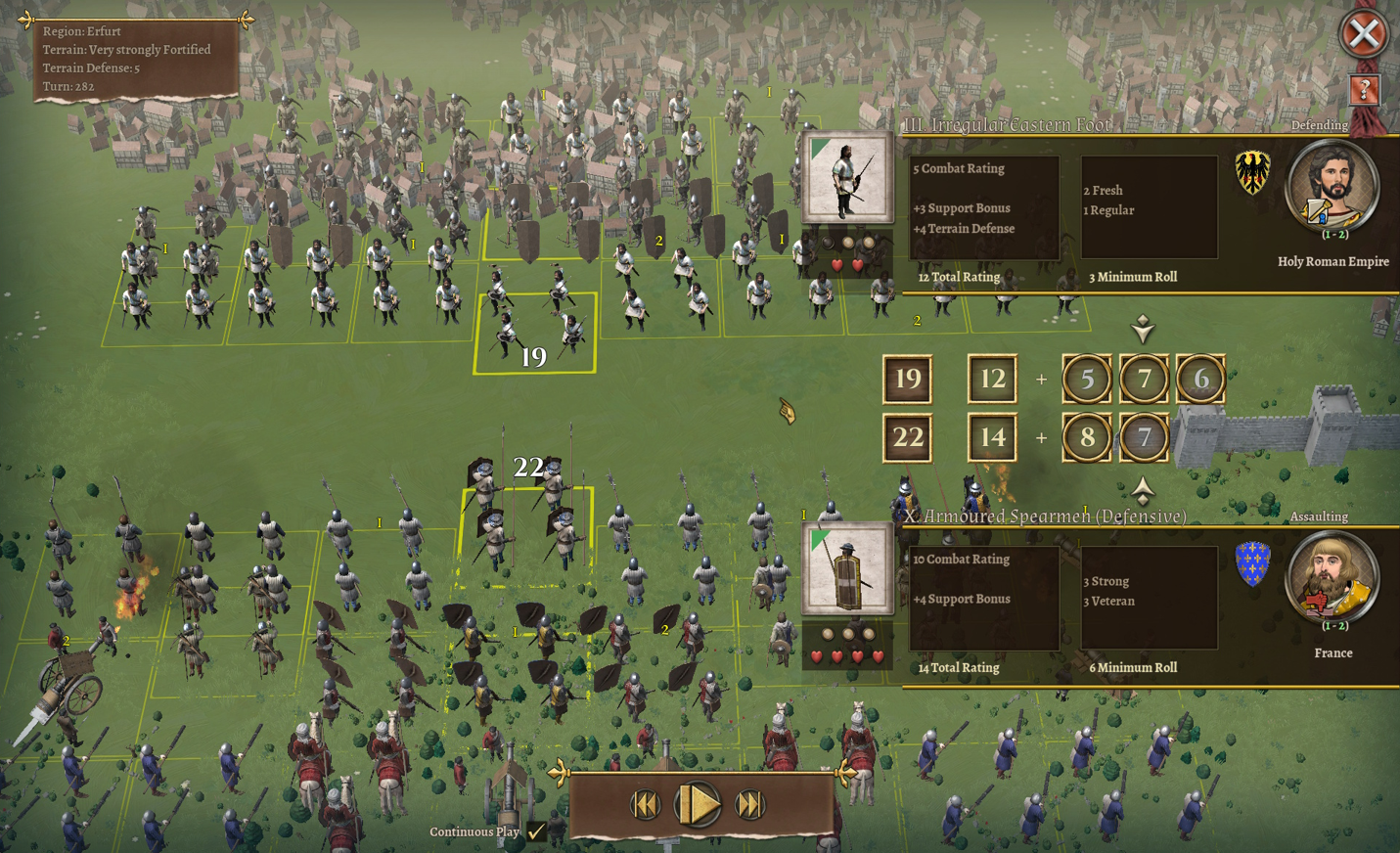
French artillery support fire against Holy Roman Empire troops
A Broader Military Shift
Gunpowder does not exist in isolation. Six new general military buildings reflect the wider transformation of warfare.
A few examples include royal harness workshops, which improve heavy cavalry equipment immediately upon recruitment, and wagon train depots, which enhance logistical efficiency across the realm by improving the conversion of food into supply and making sustained campaigns more viable.
Together, these buildings reinforce a central idea: late medieval warfare is no longer defined solely by levies and feudal obligations. It becomes professional, industrial, and increasingly dependent on planning rather than tradition. Players should also expect to rely more on standing armies and less on levies. This demands a stronger economy, but those familiar with the previous dev diary on advanced economy and burghers already know how to prepare for it.
Gunpowder marks the beginning of this transition. Not as a clean break, but as a long, costly, and often uncertain evolution that reshapes both castles and armies, and ultimately pushes the medieval world toward a new art of war.