The second DLC for Kingdoms, Burghers and Bombards, also introduces what we call the advanced economy. The decision to add new concepts related to monetary income and expenditure stems from two main goals. First, to at least partially address the issue of monetary revenues becoming too easy to accumulate in the later stages of the game. Second, to bring an additional layer of historical plausibility, without falling into heavy-handed simulation.
This advanced economy is built around three main pillars, with wide-ranging implications. It goes well beyond the simple management of coins and treasuries.
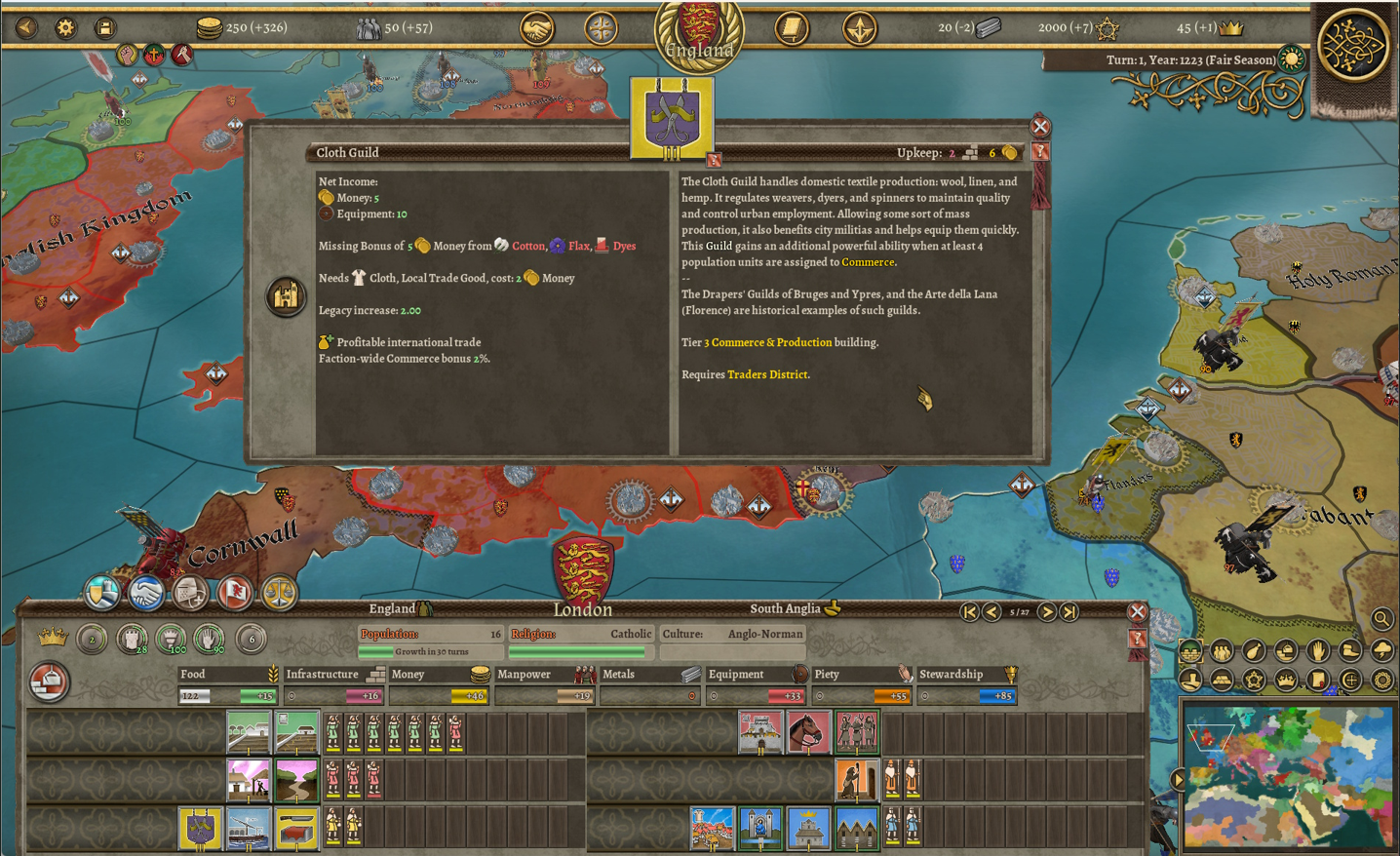 The London Cloth Guild is very appealing thanks to its base ability, even before taking into account its additional ability unlocked with four populations working in trade.
The first pillar is the introduction of an additional gold maintenance cost for buildings, applied in a very gradual way. This upkeep is entirely absent during the first century of the base campaign, which of course fully and organically benefits from the feature if you own the DLC. From the second half of the 12th century onward, many buildings will start to incur a gold maintenance cost. This naturally encourages more careful optimization, for example by actively triggering the revenue bonuses of these buildings, if you wish to maintain a comfortable monetary surplus. Unchecked gold hoarding is otherwise strongly curtailed. Historically, almost all rulers had to resort to considerable creativity, and often injustice, to raise the funds required for court expenses and military campaigns.
This monetary upkeep is not only progressive over time, but also tailored to each building. Agricultural structures and basic infrastructure are far less penalized than buildings tied to more advanced or specialized functions. Tier I buildings have modest upkeep compared to Tier II, and even more so compared to Tier III buildings, a new tier introduced with this DLC. Expect to pay a steep price for a Winter Palace or even a Falconry, one of the new buildings. Noblesse oblige.
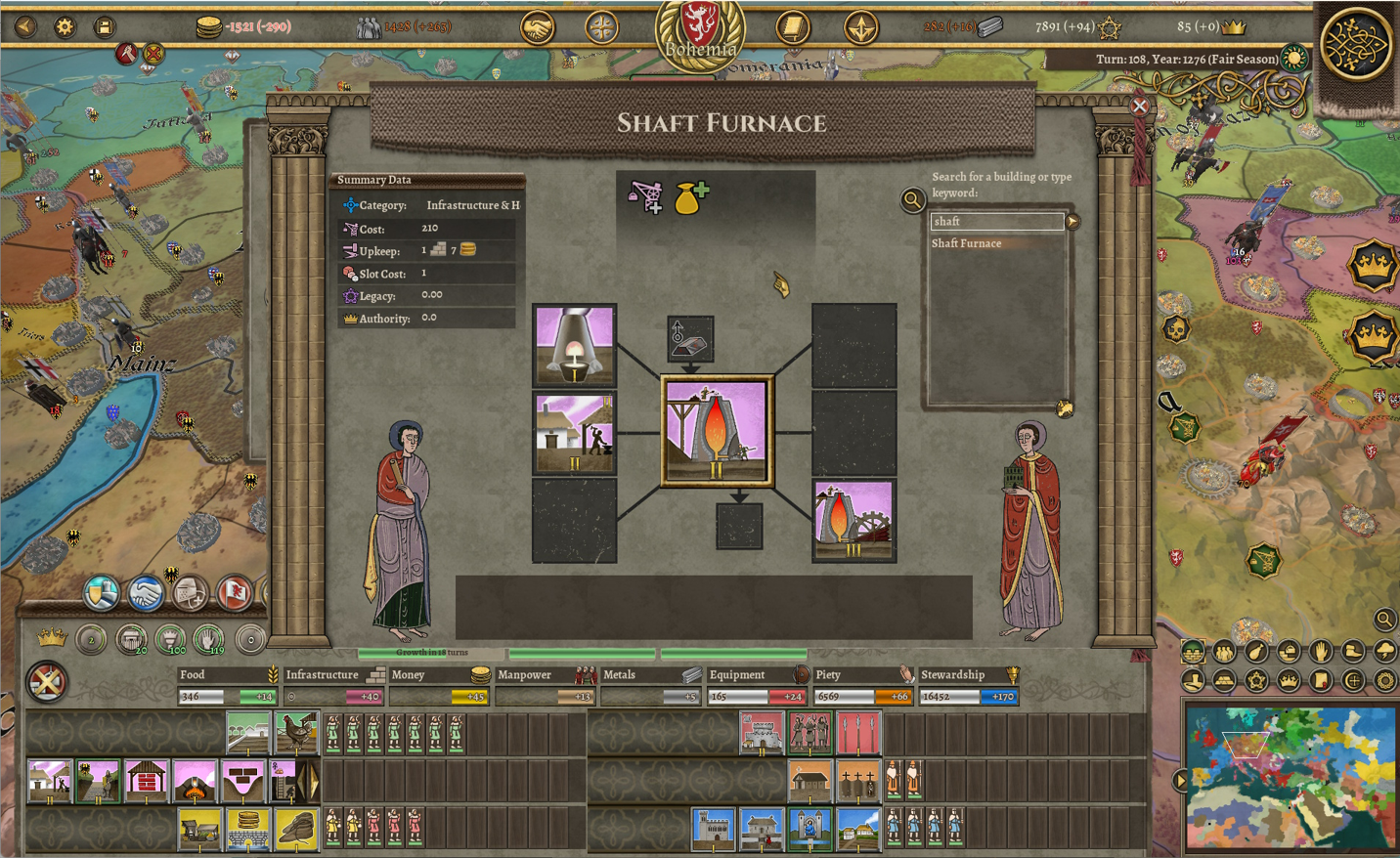 Most buildings now come with an additional monetary upkeep, such as the 7 gold maintenance cost of this Blast Furnace.
The second pillar is inflation. It can be negative, reducing costs, but will more often be positive, depending on the development of your realm. Inflation affects the maintenance costs of both buildings and units, acting like a slow, creeping poison. At this stage, we deliberately chose not to impact purchase costs, in order to avoid creating insurmountable upfront expenses. As you may recall, many high-quality units, often standing army units, already have costs that increase with the number you own. Inflation can nevertheless be fought, notably through certain guilds and banking systems, but most of the time it will have to be endured as an additional burden, partially offsetting the very generous revenues of large and wealthy nations.
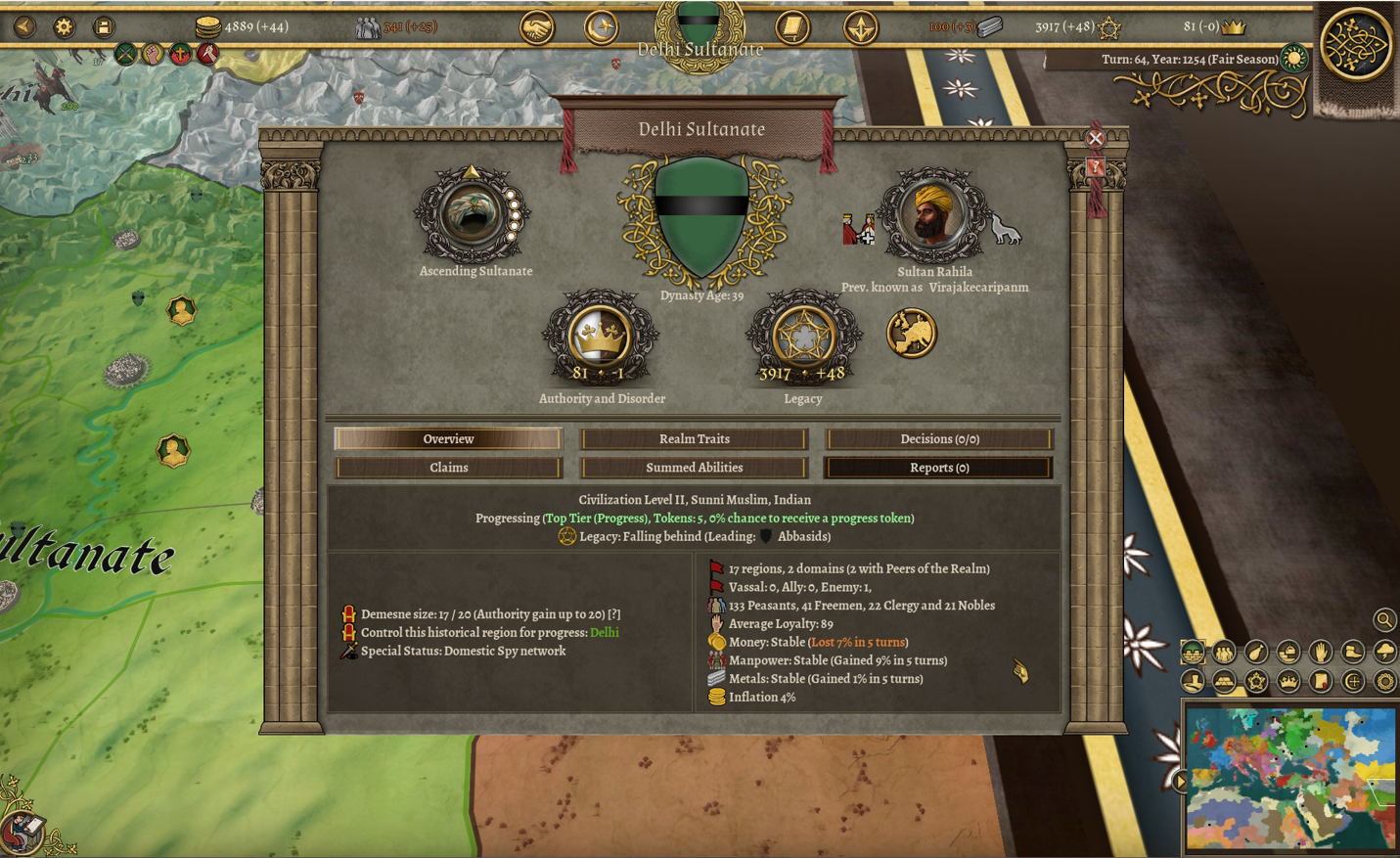 The Sultanate of Delhi on turn 64 (year 1254) has a small monetary margin, but a solid reserve. Its 4% inflation remains moderate and not particularly worrying.
Finally, and perhaps most importantly, comes the introduction of a new social class: the Burghers. Emerging strongly during the 12th century, this class reflects the transformation and growing sophistication of economic practices. Guilds, effectively professional corporations, become increasingly common. Non-noble merchants gain wealth, influence, and confidence, and are no longer willing to submit unquestioningly to feudal lords. They may not be nobles, but they control the lifeblood of war and politics: money. As such, they seek a growing role in the life of cities and, by extension, of the realm as a whole.
Historically, many rulers relied on the burghers to counterbalance the power of the high nobility. This dynamic often created opportunities for the emergence of municipal councils and city charters granting greater freedom and autonomy. In game terms, the Burghers form a new population class, also present among tribal factions where they represent wealthy merchants. In Christian realms, they favor the appearance of Guilds, powerful Tier III buildings that we will detail further in an upcoming diary. These buildings unlock a particularly strong ability if the region hosts a sufficiently large commercial population, opening up new optimization strategies that we hope you will find both engaging and rewarding.
The presence of Burghers also triggers new multi-choice events, forcing you to take sides between the bourgeoisie and the nobility, each choice carrying its own consequences. We hope these new dynamics will offer fresh challenges to rulers and bring renewed depth to your campaigns.
As always, in multiplayer it is sufficient for the host to own the DLC for all participants to benefit from the full set of features.
See you soon for the next diary, which will focus on the arrival of gunpowder and the necessary adaptation of castles to this profound military revolution.