A few days ago we hosted a live event on our Twitch channel to update you on Broken Arrow’s development progress. In case you missed it, you can re-watch it here. Below, you’ll find a recap of what was discussed. Thanks for your continued support, the game will continue to evolve according to the Roadmap and your feedback. The next live event will be held in March.
ROADMAP, BALTIC BATTALION AND UPDATE 13 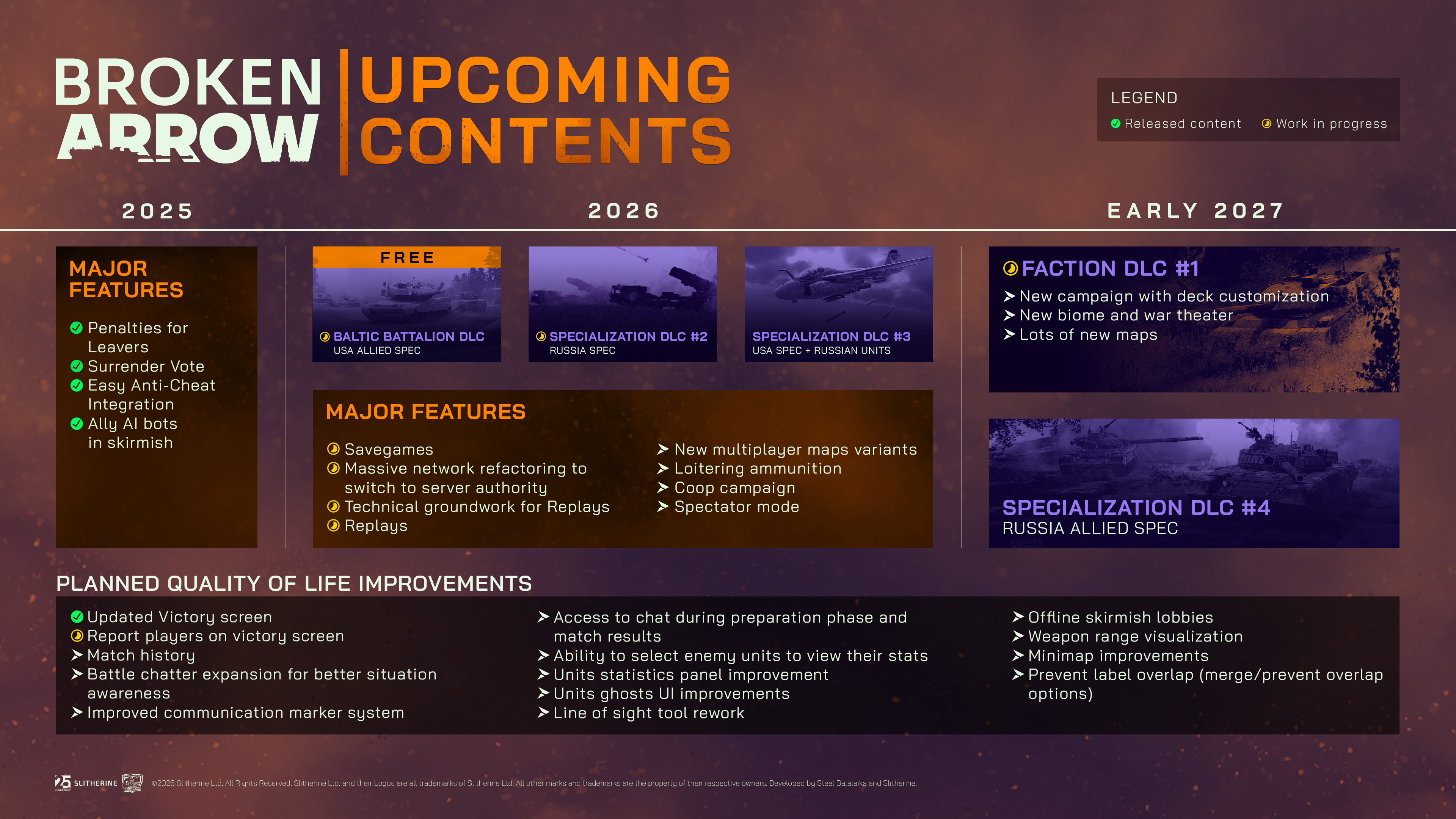
What has the team been working on recently, and what are you focusing on right now?
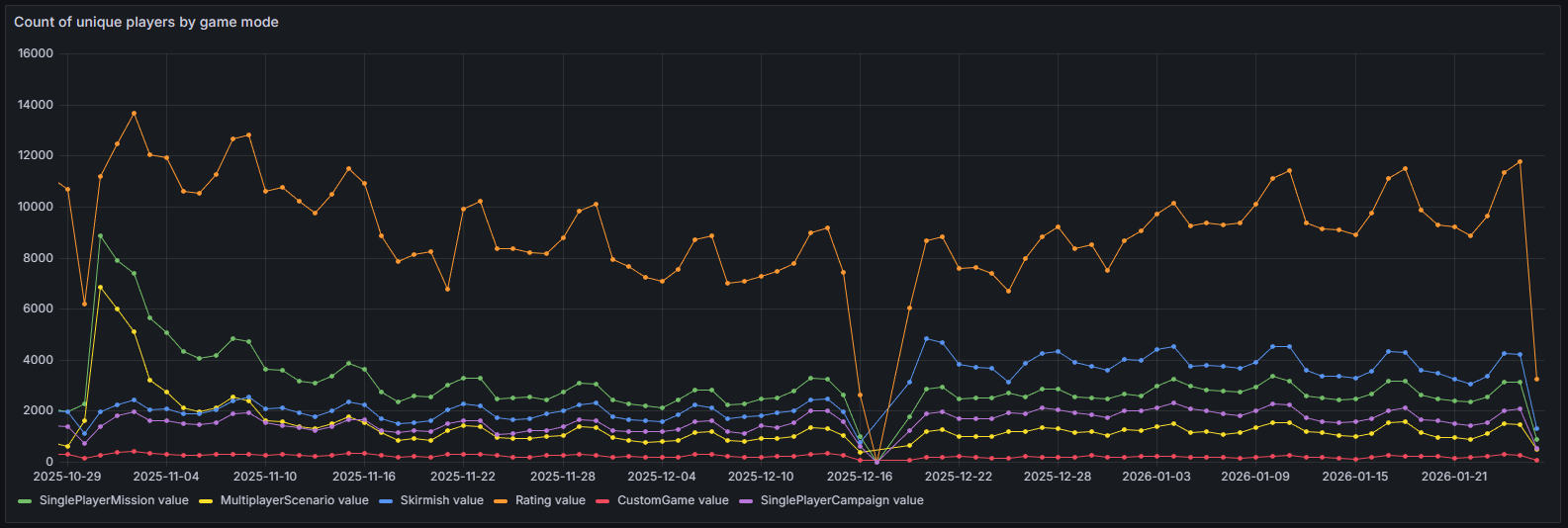
Over the past weeks, our main focus has been on improving accessibility and engagement across different playstyles. One of the most important additions since the last roadmap update has been the Skirmish AI, including the ability to play with AI allies, not just against them. This was something we had planned for a long time, and the response has exceeded our expectations. After the patch went live, we saw a clear reversal in the player trend: daily activity increased, and the number of players engaging with Skirmish mode effectively doubled.
Beyond Skirmish AI, we also shipped several important supporting improvements. We updated the victory screen to give players clearer post-match statistics through an external interface, and we made meaningful progress on network stability. Many players reported fewer visual desynchronizations and a smoother experience overall. At the moment, however, our primary focus is on finalizing the first DLC, Baltic Battalion, alongside the systems and balance changes that will ship with it.
What is the current status of the Baltic Battalion DLC, and when can players expect it?
The Baltic Battalion free DLC is now in its final stages of development, we cannot give an exact release date yet. One thing we want to clarify is that this DLC involved far more work than simply moving campaign units into multiplayer. Units that appear briefly in campaign missions do not require the same level of depth, polish, or flexibility as fully playable multiplayer content.
For the DLC, we created more than thirty new or heavily revised 3D models, added full customization systems for all units, and produced new hand-painted portraits. We also had to add complete voice acting support, which was not present for these units in the campaign. On top of that, we made a deliberate decision to have Baltic units use battle chatter in their native languages: Lithuanian, Latvian, and Estonian. Which required additional coordination and community involvement. At this point, the remaining step is recording and integrating the final voice lines, after which the DLC will be ready to release.
What is the next major update?
The next major update is Update 13, which will launch alongside the free Baltic Battalion DLC. It includes balance changes, new features, network improvements, and the DLC content itself.
What can players expect from Update 13?
Update 13 is designed to accompany the release of the Baltic Battalion DLC and is one of our more substantial updates since launch. A major part of it is a balance pass, both to address existing issues and to ensure that the arrival of new Baltic units does not further skew faction performance. At the moment, the US faction is statistically dominant (around 53% victory rate) and we are actively adjusting systems and units to maintain competitive integrity.
In parallel, Update 13 introduces several gameplay and quality-of-life improvements. One example is emergency airdrops, which allow players to deploy airborne units instantly instead of planning drops far in advance. We are also improving infantry management by allowing resupply while units remain inside transports, reducing unnecessary micromanagement. Other changes, such as unloading delays and stress transfer from destroyed transports to infantry, aim to improve realism and eliminate edge cases that felt unfair or unintuitive.
The update also includes Streamer Safe Mode, which allows streamers to hide identifying information and chat to prevent harassment. Finally, we are introducing ELO compression (not a reset) to reduce rating inflation and improve matchmaking accuracy going forward.
What is the Public Test Environment (PTE), and why are you introducing it?
The Public Test Environment is an optional beta branch that players can opt into through Steam. The purpose of this branch is to give us the freedom to test more aggressive or experimental changes without risking the stability of the main game. On the live branch, we have to be extremely cautious with changes, as even small regressions can negatively impact a large number of players.
By contrast, the beta branch is explicitly opt-in. Players who join it understand that they may encounter bugs or incomplete features, but in return, they get early access to upcoming changes and the ability to influence development through direct feedback. If a feature proves successful and stable, we move it to the main branch. If it doesn’t, we can iterate or discard it without consequences for the wider player base.
Will the beta branch affect ELO or progression?
No. The beta branch uses a completely separate profile. Any matches played there will not affect your main account, ELO, or progression. This is intentional, so players can freely test changes without risk.
Exploits, bugs, and fair play
We rely heavily on the community to help us identify exploits and unintended mechanics. We ask players to report these issues through proper channels rather than abusing or spreading them. Many problems persist simply because they are discussed informally and never reach us in a reproducible form.
To improve this, the next update will allow players to report others directly from the end-of-match screen. Additionally, we are moving economy calculations fully to the server, which will permanently eliminate an entire class of economy-related exploits and cheating. This is part of our broader effort to strengthen server authority and improve fairness across the board.
Q&A SESSION
How effective has Easy Anti-Cheat been, and did it cause performance issues?
Easy Anti-Cheat has been effective in achieving its primary goal, which is reducing cheating and helping us cross-reference data with our internal anti-cheat systems. Many cheats that were previously possible are now completely blocked, and we are detecting problematic behavior more reliably than before.
That said, the initial implementation did introduce performance issues for some players, particularly freezes. Most of these issues have already been resolved in subsequent patches. In cases where problems persist, we investigate them individually, often working directly with affected players to identify hardware or configuration-specific causes. Connection-related kicks can still occur if the game cannot communicate with Easy Anti-Cheat servers, which depends on external network factors beyond our direct control.
What are your plans to improve netcode and networking?
Our long-term networking strategy is to move more gameplay authority to the server. This reduces inconsistencies between clients and prevents situations where different players see conflicting outcomes. For example, events like missile interceptions or explosions should be resolved definitively by the server, not interpreted differently by individual machines.
However, this approach comes with technical trade-offs. Server-side calculation increases hardware requirements and makes the game more sensitive to latency. As a result, we are moving systems to the server incrementally, evaluating the impact of each change before proceeding further. Recent patches already improved synchronization, and we will continue this process step by step.
Why were save games and replays not available at launch?
Save games and replays were excluded not because we didn’t consider them important, but because early architectural decisions made them extremely costly to implement at the time. Adding them before release would have required a deep rework of core systems and delayed launch by at least a year.
Now that the game is live, we have much clearer data on player priorities, and it is evident that saves and replays are highly requested features. We are actively working on them, but they require significant foundational changes. Realistically, this is a multi-month effort and we are targeting later this year.
Are replays making progress?
We know replays are one of the most requested features and we want to be transparent about why they are taking time and where we currently stand. A proper replay system is not something that can be added in isolation, it depends heavily on how much authority the server has over the game simulation. At launch, several parts of the simulation were still handled client-side, which made implementing reliable and accurate replays impossible without major refactoring.
Over the past updates, a significant amount of work has gone into progressively moving more systems to be fully server-authoritative. This includes combat resolution, unit states and economic calculations. Replays sit at the very end of this process, because they require the server to be the single source of truth for every relevant action and state change during a match. Without that, replays would desync, show incorrect information or fail entirely.
Because of this dependency, adding replays earlier would have either resulted in a broken feature or delayed the initial release by a substantial amount of time. Instead, we chose to ship the game first and continue strengthening the underlying architecture post-launch. With each update that increases server authority, we are getting closer to a point where a replay system becomes technically viable and stable. While we can’t commit to a release date yet, replay support remains a core long-term goal and is actively tied to the ongoing networking improvements.
Will PvE content continue to evolve?
Yes, absolutely. We plan to continue adding PvE content regularly. The Baltic Battalion DLC includes a new mission designed specifically to showcase the new units, playable both solo and in co-op. Players can choose which Baltic nation to play, offering multiple variations of the same scenario.
Our data shows that while PvE missions do not have the same long-term replay rate as multiplayer, they consistently generate engagement spikes and appeal to a dedicated portion of the community. For that reason, PvE remains an important pillar of the game.
What is your approach to balance going forward?
Balance is an ongoing process, especially in a live multiplayer game. Some issues are clear enough that we can address them directly, such as faction dominance or specific unit spam strategies. Other changes are more experimental and will be tested in the beta branch before being finalized.
We also try to separate technical updates from balance patches whenever possible. This makes feedback clearer and allows us to identify the source of new issues more effectively. Not every change is about win rates, many are about improving usability, pacing, and overall enjoyment.
Are additional matchmaking modes planned?
At the moment, we are focusing on 5vs5 matches. Adding different team sizes risks splitting the player base and increasing queue times. Adding very different modes, such as one-versus-one, would require entirely separate balance considerations and could dilute our focus.
Once observer mode and competitive tooling are more mature, we may revisit alternative formats, but for now, maintaining a strong, unified core mode is the priority.
What is the status of tournament support?
Observer mode is the key missing piece for official tournaments. Once it is implemented, we will be in a position to properly support casters, organizers, and competitive events. We are already seeing impressive community-run tournaments using creative workarounds, and we want to give those organizers proper tools rather than relying on improvised solutions.
Are you planning separate ELO ratings per faction?
Yes, this is something we are actively considering and agree would be a meaningful improvement. Many players specialize in one faction, and switching factions at a high ELO often results in frustrating, mismatched games. Separate faction ELO would allow players to experiment and learn without being unfairly punished.